Google Project Suncatcher : Why Orbital AI Solves the Terrestrial Power Grid Crisis
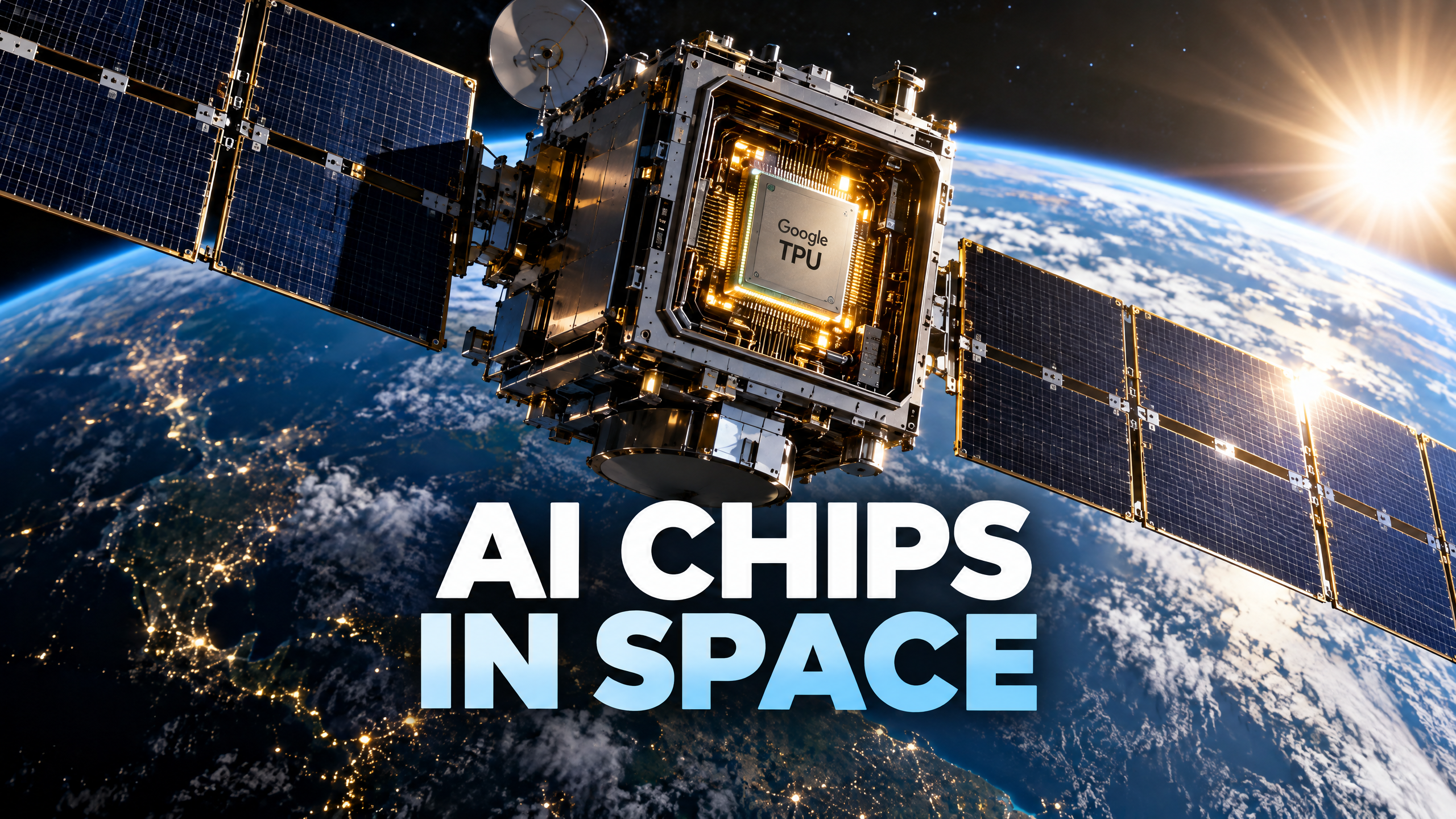
When Google announced that it had successfully launched AI chips into space, many developers laughed it off as a publicity stunt. Sending computer chips into low-Earth orbit sounded like science fiction or an expensive PR campaign.
When I started digging into the energy numbers behind our current data centers, my perspective changed completely.
Right now, ground-based AI data centers are hitting an impenetrable wall. If you want to build a modern 1-gigawatt AI training cluster on Earth today, local utility companies will tell you that you have to wait four to seven years just to connect to the power grid. Worse, those same facilities consume millions of gallons of fresh water every day to keep servers from overheating, often competing directly with municipal drinking water supplies.
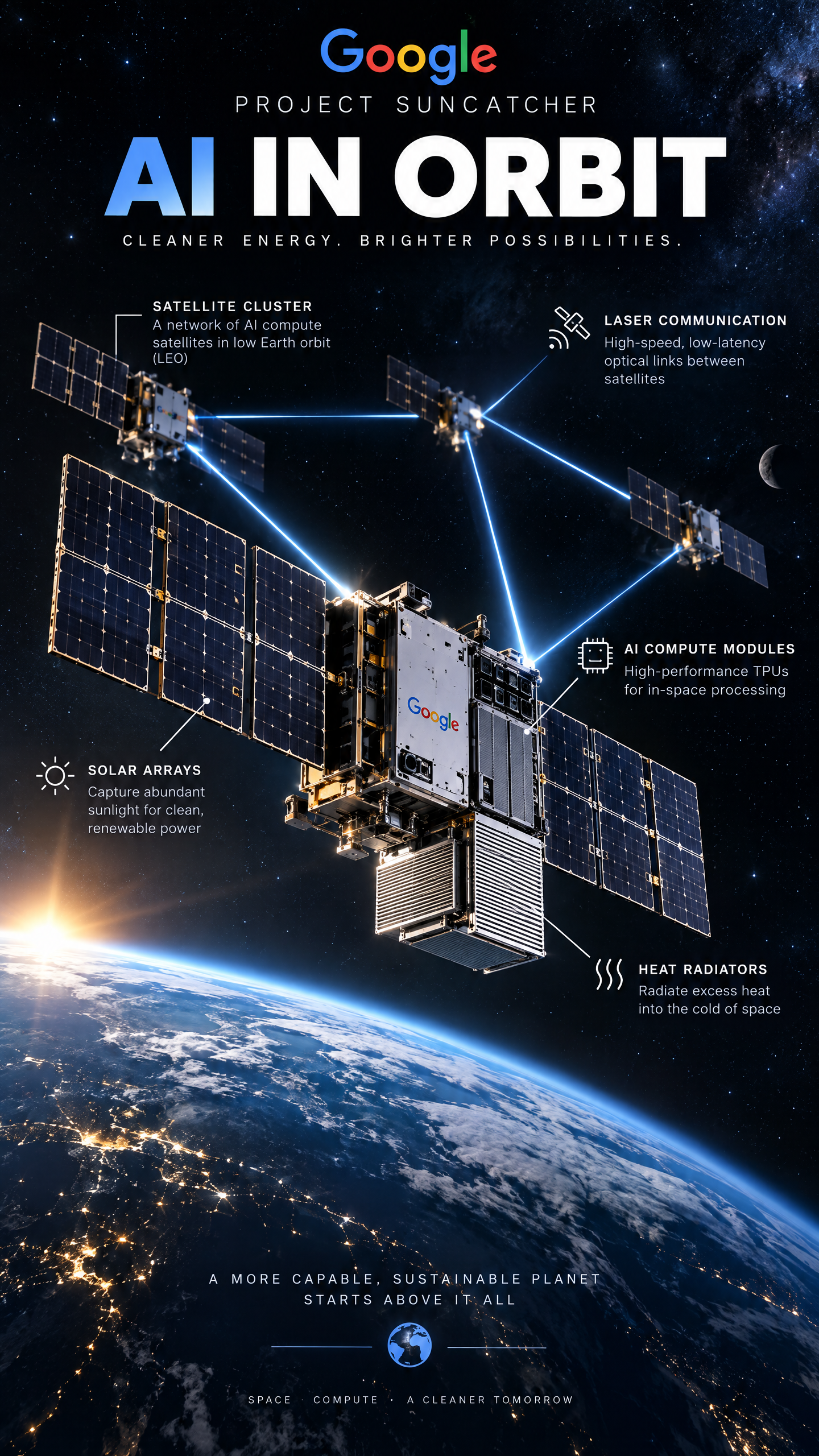
Google's moonshot initiative—called Google Project Suncatcher—aims to bypass that entire terrestrial logjam by taking machine learning hardware off our planet entirely.
Here is an honest breakdown of the economics, the solar power advantage, the brutal cooling physics, and why putting AI into orbit may soon become cheaper than building on solid ground.
The Terrestrial Crisis: Why Earth Is Running Out of Data Center Power
To understand why putting chips in orbit makes sense, you first have to look at the power crisis facing machine learning facilities on Earth:
- Grid Interconnection Delays: Securing approvals to draw 500 megawatts to 1 gigawatt of power from regional electrical grids now takes between 4 and 7 years across North America and Europe.
- Water Depletion: A single hyperscale data center can evaporate up to 5 million gallons of drinking water daily through evaporative cooling towers.
- Land & Permitting Costs: Purchasing hundreds of acres of industrial land, building concrete bunkers, and installing high-voltage substations requires billions of dollars before a single server rack is powered on.
- Intermittent Clean Energy: Terrestrial solar farms only generate power for roughly 6 to 8 hours a day, requiring expensive battery banks or natural gas peaker plants to maintain 24/7 uptime.
In orbit, virtually every one of these economic assumptions flips on its head.
Ground AI Facility:  Land Purchase ($) → Substation (5-Yr Wait) → Water Cooling (Millions Gal/Day) → Grid Strain
         VS
Orbital AI Cluster:  SpaceX Launch ($200/kg) → 24/7 Unattenuated Sun (8x Energy) → Radiative Vacuum → Zero Grid Impact
The Solar Advantage: 8x More Energy in Sun-Synchronous Orbit
On October 1, 2026, Google launched its first prototype test satellite aboard a SpaceX Falcon 9 rocket on the Transporter-18 rideshare mission.
The satellite was inserted into a 650-kilometer dawn-dusk Sun-Synchronous Orbit (SSO). In this specific polar orbit, the satellite rides along the Earth's day-night terminator line. Because of the orbital geometry, the satellite remains in continuous, unblinking sunlight 24 hours a day, 365 days a year.
                      Sunlight (1,361 W/m²)
                          │  │  │  │
                          ▼  ▼  ▼  ▼
                 ┌────────────────────────┐
                 │  Dawn-Dusk SSO Orbit   │ ◄── Zero Night Cycles
                 │   (Continuous Sun)     │
                 └───────────┬────────────┘
                             │
            ┌────────────────┴────────────────┐
            ▼                                 ▼
   Terrestrial Solar                 Orbital Solar Array
   - Atmospheric absorption (30%)    - Zero atmosphere attenuation
   - Night cycles & weather          - Constant 1,361 W/m² irradiance
   - 150–250 W/m² effective          - ~8× higher daily energy harvest
In space, solar panels receive unattenuated sunlight measuring roughly 1,361 Watts per square meter. On Earth, after sunlight passes through the atmosphere, clouds, and night cycles, average daily solar yield drops to just 150 to 250 Watts per square meter.
That means an orbital solar array captures up to eight times more raw energy over a 24-hour period than an identical solar installation in the Arizona desert, without requiring massive chemical battery storage.
Launch Economics: The $200 per Kilogram Parity Threshold
Historically, putting anything into space cost tens of thousands of dollars per kilogram, making orbital computing laughable. But launch economics have collapsed:
| Launch Era | Typical Vehicle | Average Cost per Kilogram | Viability for AI Compute |
|---|---|---|---|
| Space Shuttle (1990s) | Space Shuttle | ~$54,000 / kg | Completely impossible |
| Falcon 9 Rideshare (Current) | Falcon 9 | ~$2,500 – $5,000 / kg | Prototype testing only |
| Next-Gen Heavy Lift (Starship Target) | Starship | ~$100 – $200 / kg | Economically competitive with land data centers |
At $200 per kilogram, the capital cost to launch lightweight, ruggedized compute modules into low-Earth orbit begins to undercut the multi-billion-dollar price tag of acquiring land, building concrete shells, and paying utility interconnection tariffs on Earth.
When you factor in zero property taxes, zero land leases, and free, perpetual solar power, the operational expenditure (OpEx) of an orbital cluster drops dramatically over a five-year operational lifespan.
The Vacuum Bottleneck: Stefan-Boltzmann Radiative Cooling
Space is cold, but space is also an insulator. This is where most casual observers get confused.
On Earth, servers stay cool because air molecules absorb heat through fans and heat sinks (convection), or water carries heat away into chillers. In the vacuum of low-Earth orbit, there is no air. Convection is literally impossible.
Every single watt of heat generated by an AI accelerator must be conducted through solid metal heat pipes to external radiator panels and emitted into deep space purely as infrared radiation.
   Trillium TPU Core (~85°C)
              │
              ▼  (Heat Pipes / Conduction)
   External Radiator Surface
              │
              ▼  (Stefan-Boltzmann Infrared Emission: q = ε · σ · A · T⁴)
   Deep Space Cold Sink (3 Kelvin)
Because radiative cooling efficiency scales with the fourth power of temperature ($T^4$), radiating heat from a chip that must stay below 85°C requires substantial radiator surface area.
On the current prototype satellite—which packs four Google Trillium TPUs into a refrigerator-sized chassis built by Planet Labs—the thermal dissipation limits continuous TPU processing to roughly 20 minutes. After 20 minutes of full-throttle execution, the satellite must pause processing to let the radiators shed accumulated heat before the silicon throttles.
Solving this thermal constraint with deployable radiator wings and phase-change thermal storage will be the key engineering hurdle before orbital data centers can run continuous multi-day training jobs.
October 1, 2026 Flight Milestone: Gemma Speaks from Orbit
Despite these thermal realities, Google has already achieved in-orbit execution:
- Launch Vehicle: SpaceX Falcon 9 (Transporter-18 rideshare) on October 1, 2026.
- Flight Hardware: 4× Google Trillium TPUs (TPU v6e silicon) inside a Planet Labs satellite bus.
- Radiation Hardening: Silicon validated under 67 MeV proton cyclotron beams at UC Davis, exceeding three times a standard five-year low-Earth orbit radiation dose.
- In-Orbit Execution: Google successfully ran prompt inference on its open-weights Gemma model in orbit. The model generated a space haiku and beamed the output down to a ground station in Svalbard, Norway.
Terrestrial vs. Orbital Data Centers: Comparison Table
| Operational Factor | Terrestrial AI Data Center | Google Project Suncatcher Orbital Pod |
|---|---|---|
| Grid Connection Time | 4 to 7 years queue | Immediate upon orbital deployment |
| Cooling Medium | Evaporative water + forced air | Radiative cooling into space vacuum |
| Water Consumption | Millions of gallons daily | 0 gallons |
| Continuous Solar Harvest | 6 to 8 hours daily (weather dependent) | 24 hours daily (dawn-dusk SSO orbit) |
| Silicon Duty Cycle | 100% continuous 24/7 | ~20 minutes continuous per thermal cycle |
| Maintenance & Upgrades | Easy physical technician access | None (hardware discarded at end of life) |
| Inter-Node Latency | Fiber glass optic cables | Free-space lasers (30% faster than fiber) |
Verified Takeaway
Google Project Suncatcher is not an attempt to replace all cloud computing tomorrow. It is a calculated hedge against Earth's tightening energy and water constraints.
By demonstrating that custom Trillium TPUs can survive launch vibrations, operate in hard vacuum, resist solar radiation, and run actual Gemma inference tasks in space, Google has established that orbital computing is fundamentally viable. Once heavy-lift rockets lower launch costs below $200 per kilogram, the economic balance will tilt decisively toward the stars.
For our full hardware teardown, thermal calculation equations, and 2027 laser mesh roadmap, read our comprehensive investigation of Google Project Suncatcher on SoftReviewed.


Comments
Post a Comment