Google Antigravity Orchestrator Quota Economics: How Dual-Model Routing Saves 24% API Limits
What Is Google Antigravity Orchestrator?
Single-model coding agents force developers into an expensive trade-off. If you assign a frontier reasoning model like Gemini 4 Carbon to handle an entire project, it handles system architecture effortlessly, but it burns through expensive token quota on routine package installs, simple file diffs, and minor syntax edits. Conversely, switching to lightweight models saves quota but easily derails when prompts require subtle cross-file refactoring.
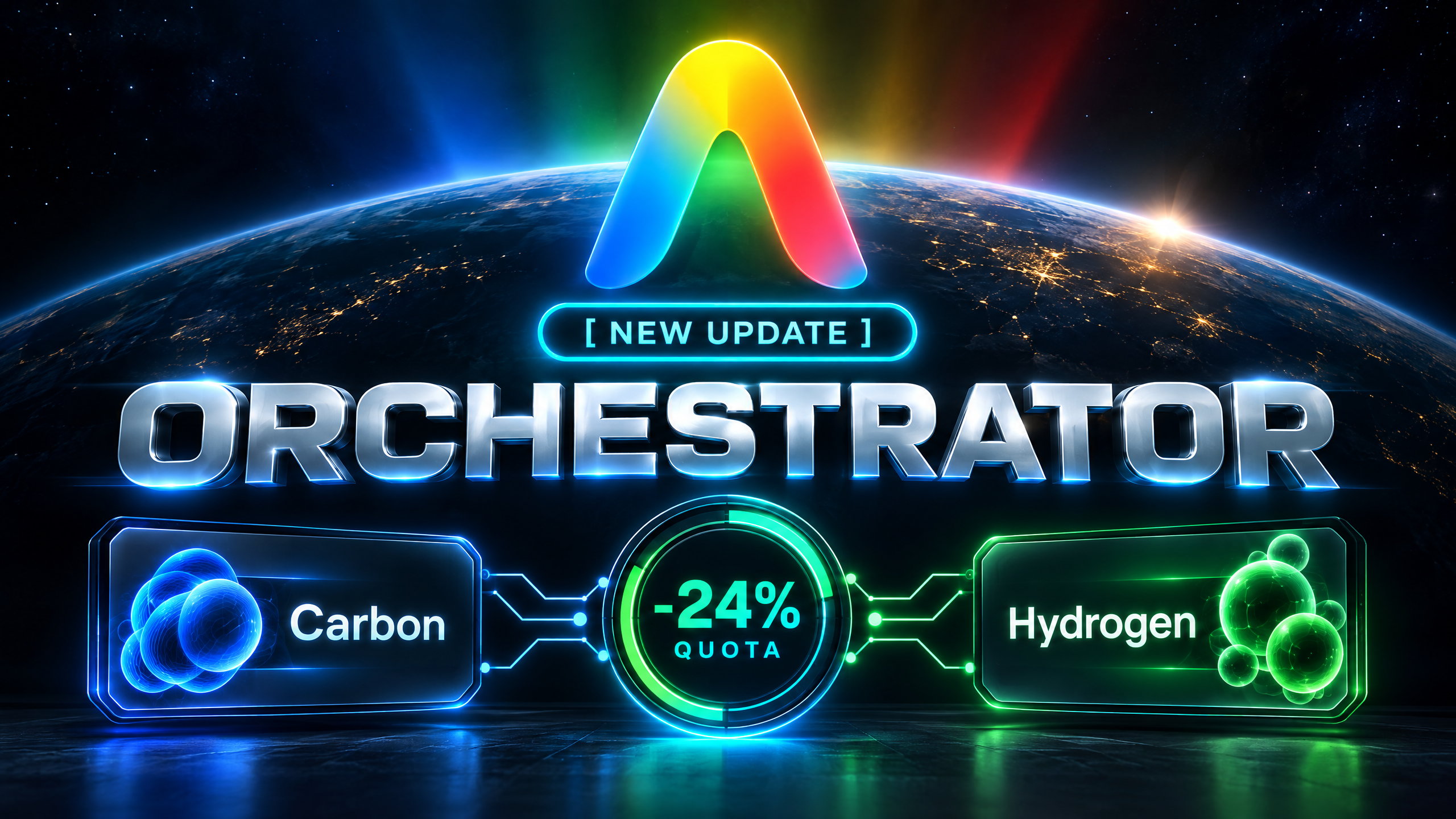
Google Antigravity Orchestrator solves this trade-off by introducing dynamic, bi-directional dual-model routing inside a single continuous conversation trajectory. Rather than guessing model difficulty upfront, Orchestrator delegates planning to high-reasoning frontier models (Gemini 4 Carbon or Argon) while routing code editing, package installs, and testing to Gemini 4 Hydrogen.
[Main Execution Trajectory]
        │
        ├── Phase 1: Read-Only Blueprint Creation ──► Gemini 4 Carbon / Argon (Plans & inspects AST)
        │
        ├── Phase 2: High-Velocity Code Edits    ──► Gemini 4 Hydrogen (Executes diffs & runs tests)
        │
        └── Phase 3: Friction Handback Loop      ──► Back to Carbon (Diagnoses errors & repairs plan)
The 3-Phase Execution Architecture
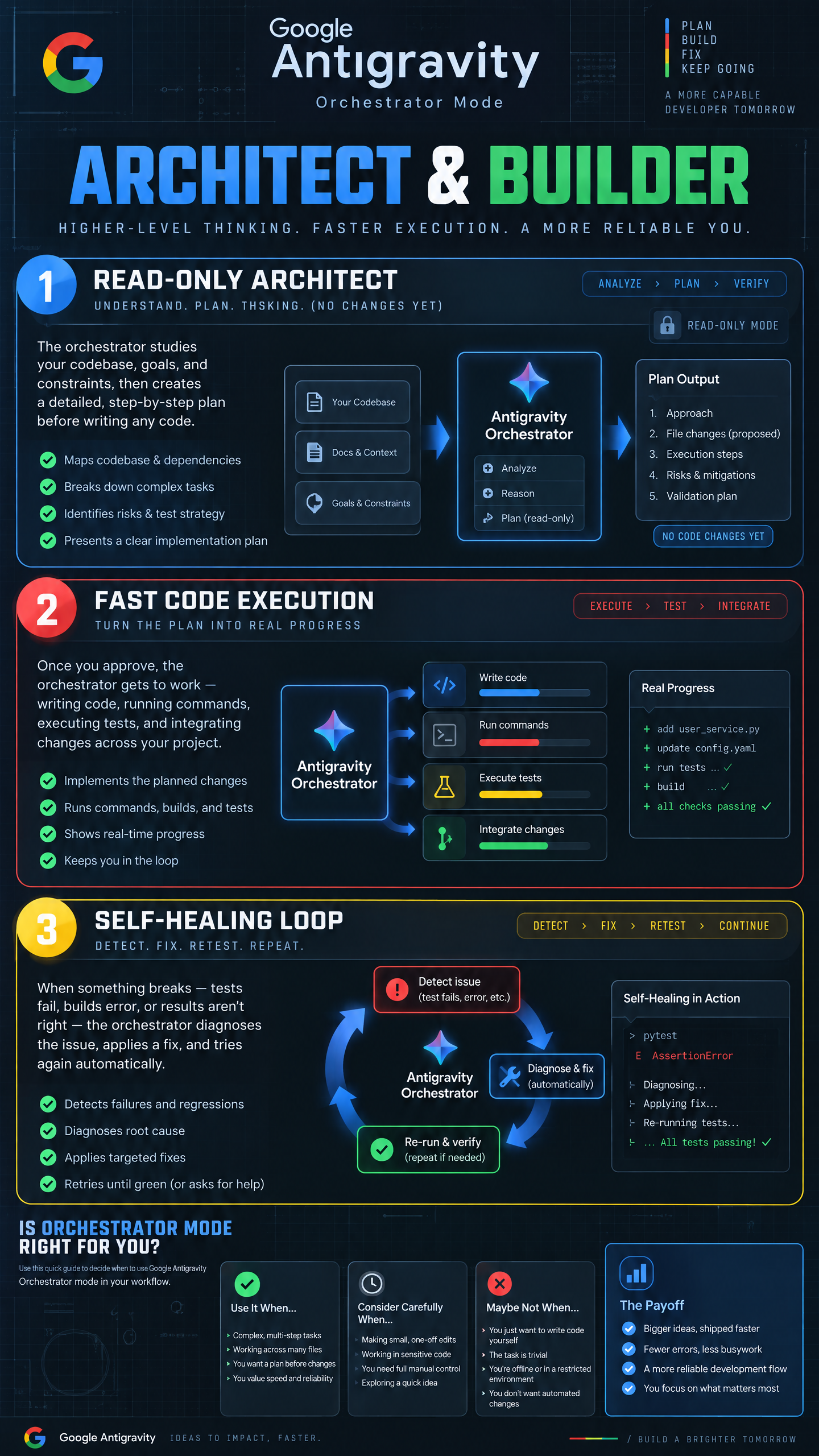
- Phase 1: Read-Only Exploration & Blueprint Creation: The frontier model operates in a read-only sandbox. It inspects directory structures, analyzes dependency graphs, and produces an execution blueprint with explicit replanning triggers.
- Phase 2: High-Velocity File Edits & Terminal Testing: Gemini 4 Hydrogen executes the physical implementation: creating file diffs, installing packages, and running terminal tests at 2.5× the velocity of Gemini 3.8 Flash.
- Phase 3: The Friction Handback & Self-Healing Loop: If tests fail or compiler errors arise, control yields back to Carbon to diagnose the root cause, adjust the master plan, and resume execution.
Terminal-Bench 4.1 Benchmark Evaluation
According to Google's official Terminal-Bench 4.1 evaluations, Orchestrator delivers near-identical accuracy compared to solo Carbon while significantly reducing resource consumption:
| Evaluation Metric | Solo Gemini 4 Carbon | Orchestrator Mode | Efficiency Gain |
|---|---|---|---|
| Terminal-Bench 4.1 Score | 57.3% | 57.0% | Near-Parity Accuracy (-0.3%) |
| Token Quota Consumption | 100% Baseline | 76% | 24% Less Quota |
| Average Task Duration | 100% Baseline | 81% | 19% Faster Completion |
| Diff Execution Velocity | Standard Reasoning | 2.5× vs Flash | Rapid File Updates |
Subscription Tiers & Access Rules
- Google AI Ultra: Unlocks both Orchestrator (Carbon) and Orchestrator (Argon). Best for deep architectural migrations and large enterprise codebases.
- Google AI Pro (Paid): Unlocks Orchestrator (Argon). Delivers the full 24% quota savings and fast Hydrogen execution for standard subscription tiers.
- Google AI Free: Standard single-model selection only; Orchestrator mode requires an active Pro or Ultra plan.
Comprehensive Architectural Teardown
👉 Read the complete technical guide, trajectory breakdown, and benchmark analysis on SoftReviewed:
Google Antigravity Orchestrator


Comments
Post a Comment