Gemini Decisions API Pricing Breakdown : $0 Output vs TypeSafe Jev 1.14 Cost Math
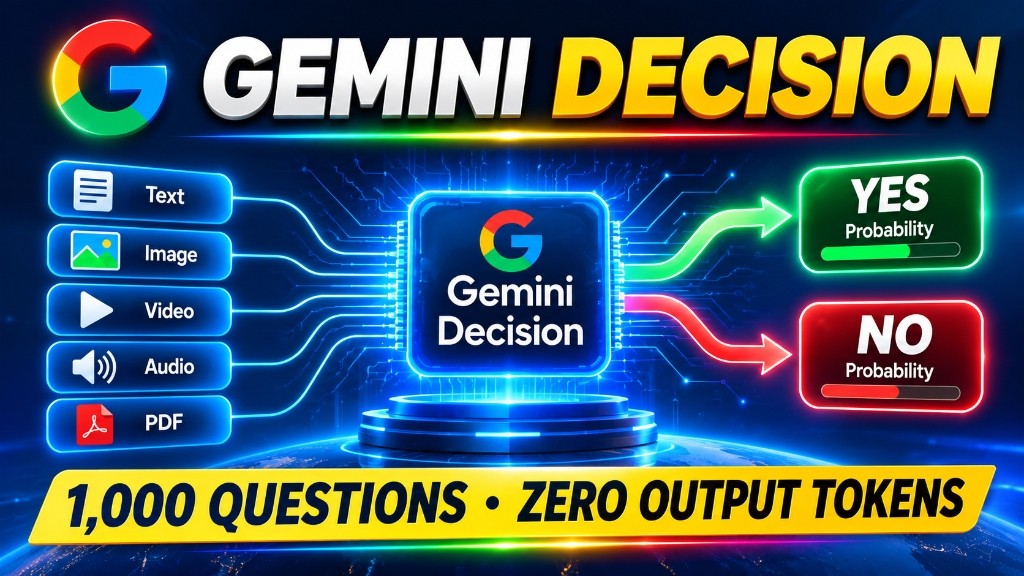
Whenever Google launches a specialized endpoint, the first tab I open is always the billing page. On November 11, 2026, Google released the Gemini Decisions API (gemini-decision-1) inside Google AI Studio (v1beta), promising up to 1,000 closed-ended checks in a single call for $0 output token charges.
That pricing pitch caught my attention right away because most teams burn money asking regular chatbots simple yes-or-no questions and paying for hundreds of generated JSON tokens in return. I went through Google's official pricing rules, the rate-limit tiers, and the independent numbers from Artificial Analysis Decision Index v2.1 to check whether Gemini Decision 1 actually saves money or if TypeSafe Jev 1.14 still wins on raw cost. Watch my 2-minute breakdown below:
How Gemini Decisions API Billing Actually Works
The Gemini Decisions API charges $0.10 per 1 million input tokens and $0 for output tokens. Zero output billing is possible because gemini-decision-1 never writes words one token at a time. Instead, it reads your text, image, audio, video, or PDF payload once in a single pass and outputs calibrated probabilities (0.01 to 0.99), selected labels, and confidence scores.
Here is the billing rule that changes your math the most: your shared input is billed only once per request. You can attach up to 1,000 independent questions (noul yes/no checks, choice picks from 2 to 255 options, or score rubrics up to 255 levels) against a single payload of up to 256K (262,144) input tokens.
When I compare that against running 10 separate chatbot calls over the same document, the difference is huge:
- Standard chatbot loop: You send a 2,000-token support thread 10 times (20,000 input tokens) and pay output rates on 10 separate JSON replies.
- Gemini Decisions API single call: You send the 2,000-token thread once, add 10 short question instructions, and pay
$0.10per 1M input tokens with $0 added for the answers.
Google's own launch test shows how fast that adds up. Across 7 shared evaluations, gemini-decision-1 cost $0.88 in total, while running the same workload on Gemini 3.5 Flash-Lite (Interactions API) cost $4.14 — roughly 5x more expensive.
Free Tier vs Tier 1 Paid: What You Get and What You Give Up
You can test gemini-decision-1 today in Google AI Studio or through OpenRouter (google/gemini-decision-1) without paying upfront, though the rate limits and privacy rules shift sharply once you move from prototyping to production.
| Plan Tier | Input / Output Price | Rate Limits | Data Privacy Caveat |
|---|---|---|---|
| Google AI Studio Free Tier | $0 / $0 | 200 RPM, 50,000 TPM, 10,000 RPD | Google may use submitted data for product improvement |
| Google AI Studio Tier 1 (Paid) | $0.10 per 1M input / $0 output | 1,500 RPM, 1,000,000 TPM, 50,000 RPD | Customer data is excluded from product improvement training |
| Higher Paid Tiers (Tier 2 / 3) | $0.10 per 1M input / $0 output | 5,000 to 15,000+ RPM | Higher daily throughput for heavy production queues |
For weekend experiments or testing a few hundred support tickets, 200 requests per minute (RPM) and 10,000 requests per day (RPD) on the Free Tier give you plenty of breathing room. Still, I never put customer emails, invoices, or internal company logs on the Free Tier because Google can use free-tier inputs to improve its products. Switching to Tier 1 Paid removes that training flag immediately while lifting your ceiling to 1,500 RPM and 1,000,000 tokens per minute (TPM).
Gemini Decision 1 vs TypeSafe Jev 1.14 vs GPT-6 Luna on Cost
If you only read Google's launch post, you might assume gemini-decision-1 is the cheapest AI decision model on the market. When I checked both Google's launch table and the independent Artificial Analysis Decision Index v2.1, a much clearer price split appeared.
On Google's 7 shared evaluations, TypeSafe Jev 1.14 actually came in cheaper at $0.68, compared to $0.88 for Gemini Decision 1 and $0.93 for OpenAI's GPT-6 Luna (Decisions API). That pattern shows up even more starkly on the independent Artificial Analysis Decision Index v2.1:
| Model (Decision Index v2.1) | Decision Index Score | Average Speed / Task | Standardized Cost (per 1M Tasks) | Token Rate |
|---|---|---|---|---|
| Gemini Decision 1 | ~66 | ~211 ms | ~$345 | $0.10 / 1M input, $0 output |
| TypeSafe Jev 1.14 | ~66.23 | ~92 ms | ~$156 | ~$0.042 / 1M input, $0 output |
| GPT-6 Luna (Decisions) | ~60.0-60.25 | ~206 ms | ~$339 | $0.10 / 1M input (secondary report) |
Seeing those numbers side by side clarified my own buying rule right away. On pure text or basic screenshot checks, TypeSafe Jev 1.14 costs less than half as much (~$156 vs ~$345 per million standardized tasks) and responds more than twice as fast (~92 ms vs ~211 ms) while scoring basically level (~66.23 vs ~66).
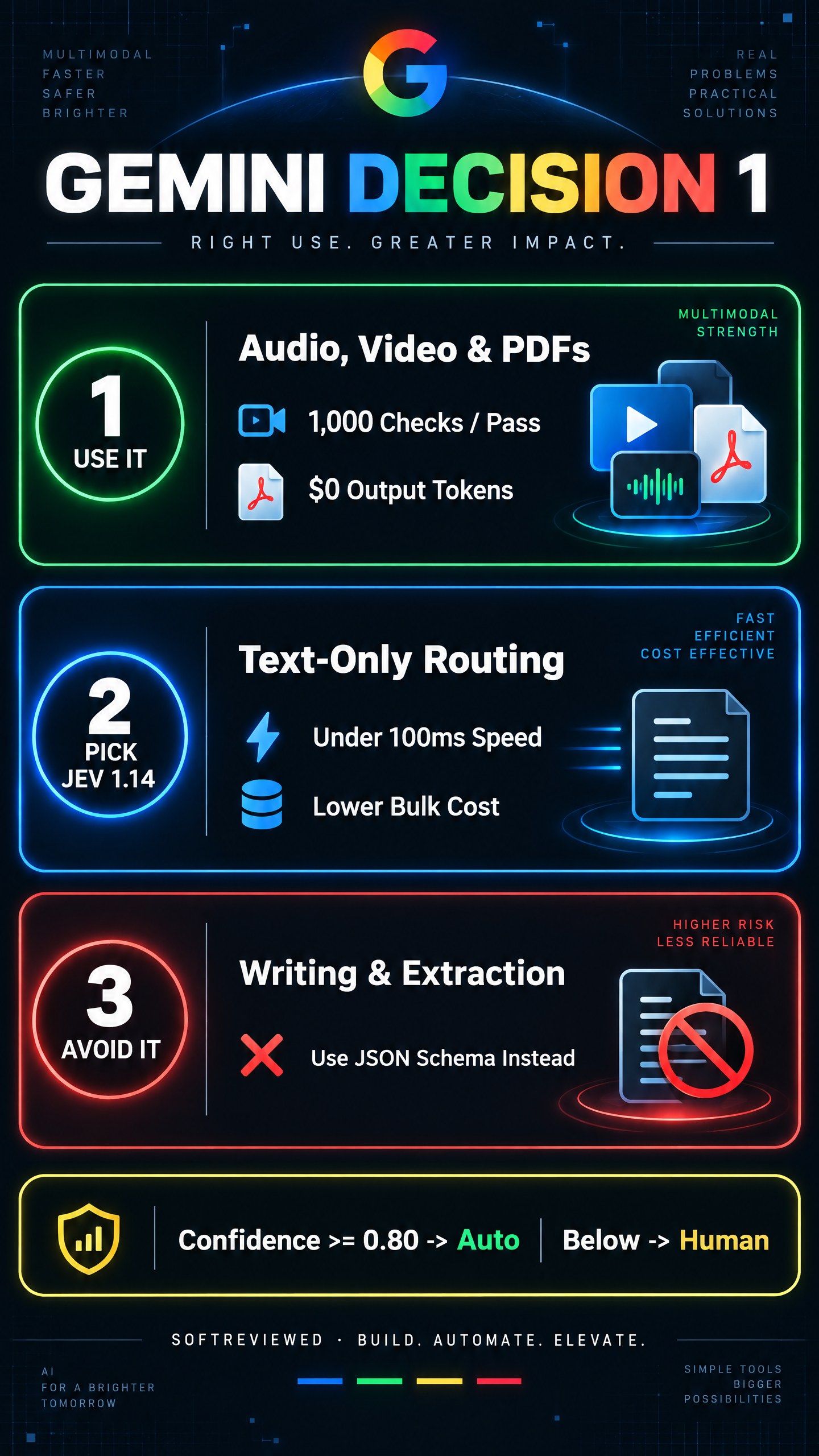
Where Gemini Decision 1 justifies its $0.10 input rate is native multimodal consolidation. Neither TypeSafe Jev 1.14 nor GPT-6 Luna reported scores on MMAU (audio) or Video-MME (video without subtitles), where Gemini Decision 1 posted 71.8% and 69.1%. If your current workflow pays an extra transcription API for call recordings or an OCR tool for dense multi-page PDFs before sending text to a classifier, dropping those extra pipeline bills makes gemini-decision-1 cheaper overall even though its raw per-token rate is higher than Jev 1.14.
Three Missing Cost-Saving Features to Watch Before Scaling
Before committing a high-volume budget to gemini-decision-1, I always check what discounts are missing at launch. Google's current documentation lists three clear gaps:
- No Context Caching: If every request sends the same 15,000-token compliance handbook plus one short customer message, you pay
$0.10per 1M tokens for the entire 15,000-token handbook on every single call. Prompt caching is not supported yet. - No Batch API, Flex, or Priority Tiers: Teams running overnight moderation sweeps usually rely on asynchronous Batch API jobs for a 50% discount. Batch, Flex, and Priority inference tiers are unavailable on
gemini-decision-1right now. - Google Cloud Vertex AI Pending: Enterprise teams looking to burn committed Google Cloud credits will have to wait, as Vertex AI support is currently listed as "coming soon."
Those missing features explain why checking your exact workload matters before migrating. If your app repeats a massive static rubric across millions of tiny inputs, missing Context Caching can quietly double or triple your monthly spend compared to a model that caches system prompts.
My Practical Buying Rule for Teams
When I weigh the token math, I split the choice into three clean lanes:
- Pick Gemini Decision 1 when your inputs mix raw audio, video clips, large PDFs, or images and you want calibrated probabilities (
0.0250Top-1 calibration error) to drive>= 0.80human-review cutoffs without paying for separate OCR or transcription tools. - Pick TypeSafe Jev 1.14 when you mainly classify text or run
When2Calltool routing (82.0%vs79.9%for Gemini) and want the lowest invoice (~$156per 1M tasks) plus sub-100 ms responses. - Skip GPT-6 Luna (Decisions) unless your company requires OpenAI billing, because it scores lower (
~60.0-60.25) at virtually the same cost (~$339per 1M tasks) as Google.
If you want to inspect the full 9-benchmark launch table, the exact Python google-genai 3.2+ request syntax, and side-by-side tradeoffs against Structured Outputs, check out my complete gemini decisions api breakdown on SoftReviewed.


Comments
Post a Comment