PHP Vulnerability 2026 : Hidden Hosting Costs and Why 70% of Servers Must Patch
PHP Vulnerability 2026 : Hidden Hosting Costs and Why 70% of Servers Must Patch
Yesterday morning, thousands of engineering directors and small business owners woke up to an urgent cybersecurity bulletin from the U.S. National Security Agency and the FBI. The guidance was unequivocal: web servers running PHP needed immediate security patches, and if organizations could not patch right away, they were advised to take systems offline.
For anyone running an online business, "taking a server offline" is not a minor operational suggestion. It represents lost e-commerce transactions, interrupted client communications, and immediate revenue disruption. Yet when an unauthenticated Remote Code Execution flaw impacts roughly 70% of the public internet, the cost of inaction is exponentially higher.
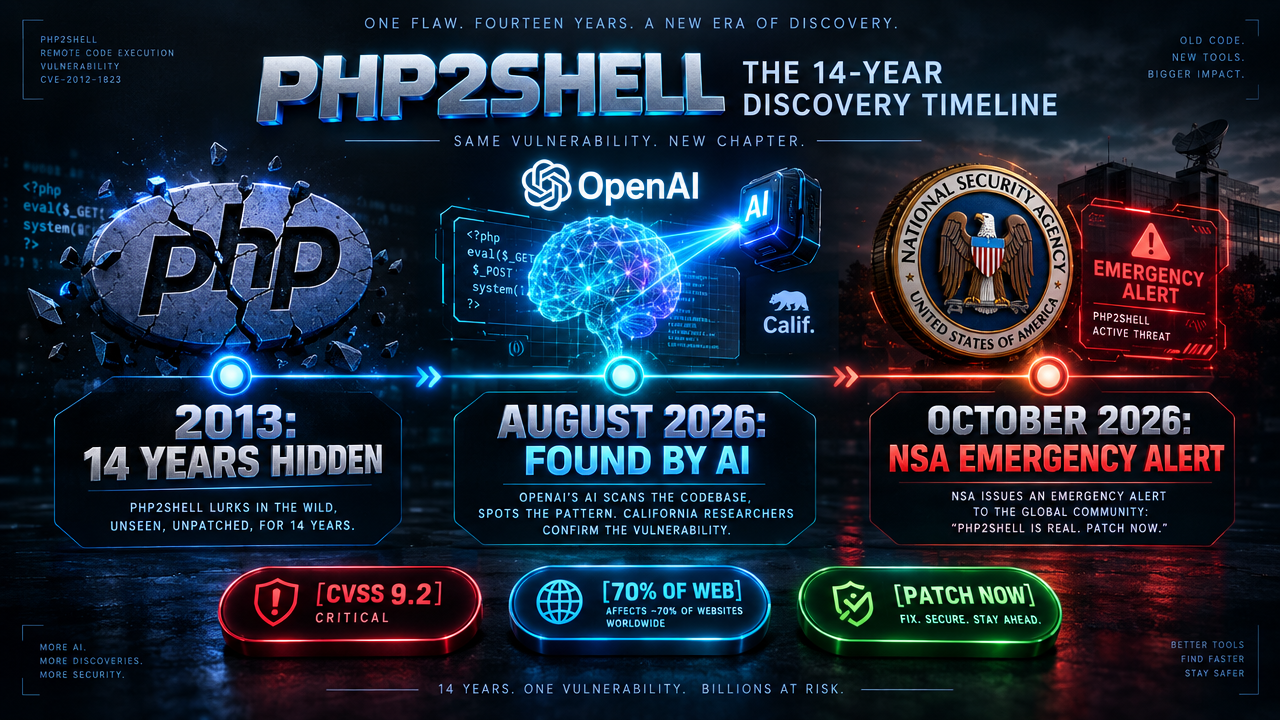
Nicknamed PHP2Shell and tracked as CVE-2026-109618 and CVE-2026-109619, this dual flaw is not a standard application bug. It sits inside the core memory cleanup loop of the PHP runtime itself, allowing an attacker to seize control of a server without needing credentials or finding an outdated plugin. If you run your web presence on modern infrastructure, reviewing this PHP2Shell security patch guide is essential to protecting your commercial investment.

The 14-Year Blindspot and the Economics of Open-Source Code
What makes PHP2Shell an extraordinary case study in enterprise risk is its longevity. Security researchers have confirmed that the underlying memory management flaws have existed in the PHP code since version 5.4 was released in 2013, with related code paths dating back to 2004.
For nearly 14 years, production servers running critical financial portals, government agencies, and storefronts executed this code without detection. Human code reviews and automated security scanners missed the interaction because the flaw only manifests during high-memory request aborts or cross-request worker reuse.
The stalemate was broken when artificial intelligence entered open-source security research. Security firm Calif, collaborating under OpenAI's "Patch the Planet" initiative, deployed GPT-5.6 Sol to audit foundational codebases. The model traced complex memory allocation routines across sequential requests and produced a working, weaponized exploit. Shortly thereafter, Wiz Research corroborated the vulnerability using their own toolset combined with Gemini 4 Argon and GPT-5.6 Sol.
Watch the 40-second video briefing below:
Understanding the Engine Flaws in Plain Terms
The financial damage caused by server exploits usually starts with how an attacker gains leverage. Unlike conventional attacks that exploit SQL injection or vulnerable contact form scripts, PHP2Shell targets the engine before application logic even evaluates the payload:
1. The Memory Halt Collision (CVE-2026-109618)
When a server receives an exceptionally large web request, PHP attempts to allocate working memory. If that request triggers PHP's internal memory limit mid-execution, the engine halts before its internal data structures are fully populated. Normal engineering logic dictates that incomplete data should be immediately purged. However, PHP's cleanup handler treated this half-built structure as legitimate, creating a window for remote shell execution.
2. The Cross-Visitor Residue (CVE-2026-109619)
Web servers use persistent worker pools to process visitors sequentially without restarting the entire runtime for every page load. Under normal circumstances, each worker process flushes its workspace before accepting the next visitor. This vulnerability allowed memory references from an earlier request to linger in the global pool. When a subsequent request arrived on that same worker, an attacker could trigger use-after-free execution, inheriting the permissions of the web server daemon.
The Hosting Cost Paradox: Shared vs. Cloud VPS
Managing hosting infrastructure always involves a financial trade-off between control and convenience. The PHP2Shell incident highlights the hidden operational costs of different hosting architectures:
1. Shared & Managed WordPress Hosting
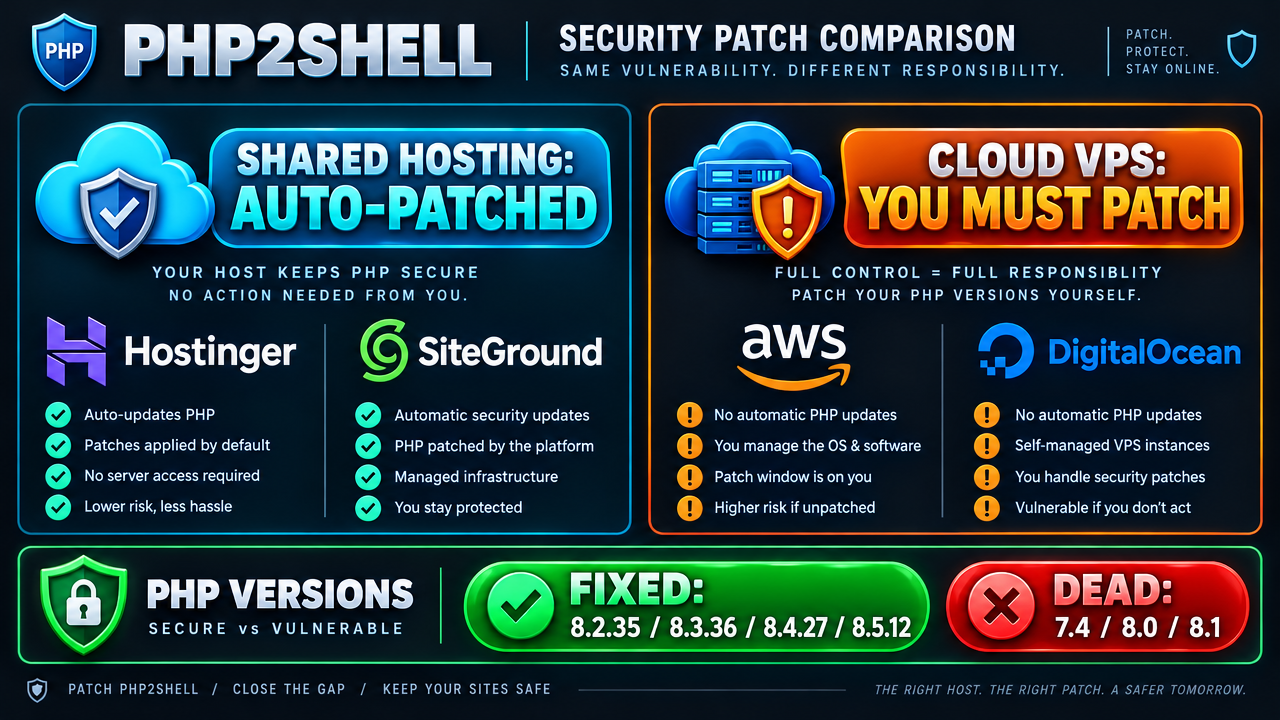
On shared platforms such as Hostinger, SiteGround, and managed cPanel hosts, the underlying server software is maintained by the hosting provider's sysadmin team. Following the emergency release, these providers initiated automated rolling updates across their fleets. For store owners on supported modern branches (PHP 8.2, 8.3, 8.4), protection was applied without requiring manual server administration.
However, there is a hidden financial trap: End-of-Life PHP legacy charges. Many web hosts charge premium legacy fees (often $10 to $20 additional per month) to keep ancient PHP 7.4 or 8.0 instances alive. Because the official PHP project will not release security patches for retired branches, paying extra to run obsolete versions now creates a direct security hazard. Upgrading to a supported version is both a financial and security necessity.
2. Cloud VPS Infrastructure
Independent cloud servers (such as AWS EC2, DigitalOcean droplets, or Oracle Cloud instances) offer high performance at low cost. But when zero-day disclosures occur, the entire maintenance burden falls on the site owner. Cloud infrastructure providers supply raw compute; they do not patch your application runtimes. A single unpatched VPS hosting multiple client sites can lead to unauthorized access, database exfiltration, and significant liability.
Commercial Action Plan for Site Owners
To protect your business continuity and avoid costly downtime, follow this verification checklist:
- Verify Runtime Version: Confirm your server is running an official patched release:
PHP 8.2.35,PHP 8.3.36,PHP 8.4.27, orPHP 8.5.12. - Review End-of-Life Versions: If your hosting dashboard indicates PHP 8.1 or older, migrate your codebase immediately to a modern, actively supported branch.
- Engage Web Application Firewalls: Keep edge WAF rules enabled on Cloudflare or your CDN layer to filter malicious multipart requests while backend updates finish deploying.
Staying protected on the modern web does not require expensive consulting contracts; it requires proactive visibility into the code powering your digital storefront.


Comments
Post a Comment