Meta Muse Wonder Full: Why It Beats Claude on Bugs, But Trails on New Apps

When I booted up my workstation this morning, I did not expect Meta to drop a frontier reasoning model that directly challenges Anthropic and OpenAI. For the past year, most people viewed Meta mainly as an open-source provider through the Llama series. But Meta's Superintelligence Labs just introduced two heavyweight frontier systems: Muse Wonder and its flagship sibling, Muse Wonder Full.
Instead of building another casual text chatbot, Meta designed these models to tackle long-running autonomous work. They are built to read multi-file codebases, remember context across weeks, and fix real bugs without giving up when an error pops up. Here is what Muse Wonder Full actually delivers based on verified benchmarks and real coding tests.
What Is Muse Wonder Full?
To understand this launch, you have to separate the two different models Meta released under the Muse family:
- Muse Wonder (
muse-wonder-1.0): The standard frontier model. It is available to developers through the Meta Model API with a 1-million-token context window ($4.00 / $20.00 per million tokens). - Muse Wonder Full (
muse-wonder-full-1.0): The flagship frontier model. This is Meta's heaviest reasoning system, tuned for deep multi-step problem solving and complex software engineering, locked inside the Muse Code subscription ($50 to $200/month).
The key differentiator from earlier coding assistants lies in two proprietary architectural mechanisms: Active Memory and Active Focus. Most AI chatbots suffer from digital amnesia—you explain your architecture, set your preferences, and close the tab. The next morning, you have to re-explain everything. Active Memory is an autonomous background retention engine that preserves repo constraints and architectural habits across separate sessions.

Infographic: Meta Muse Wonder Overview, Key Capabilities, and Artificial Analysis Scores
Official Benchmarks: Where It Beats Claude & Where It Falls Behind
On Meta's official MemoryBench evaluation, Muse Wonder scored 85.6% and Muse Wonder Full reached 85.5%, outperforming Claude Opus 5.5 (81.5%) and GPT-6 Astra (81.4%). But the real battleground is software engineering.
On autonomous bug-fixing benchmarks like DeepSWE 1.1, Muse Wonder Full claimed the global #1 spot at 79.0%, decisively beating Claude Opus 5.5 (74.2%) and GPT-6 Astra (74.1%). Furthermore, on SWE-Marathon under xHigh compute, it scored 57.5%, leading Opus 5.5 by +11.2 points. When tasked with reading existing multi-file codebases and fixing stubborn bugs, it behaves like a senior software engineer.
However, when building brand-new applications from scratch without existing starter code, a surprising gap appears. On ProgramBench (greenfield code generation), Muse Wonder Full scored 59.0%, trailing Claude Opus 5.5 (70.5%) by 11.5 points. Real-world testing confirmed this trade-off: developers found that while Muse Wonder Full dominates bug squashing, Claude Opus 5.5 is still superior at scaffolding complex 3D apps and games from an empty canvas.
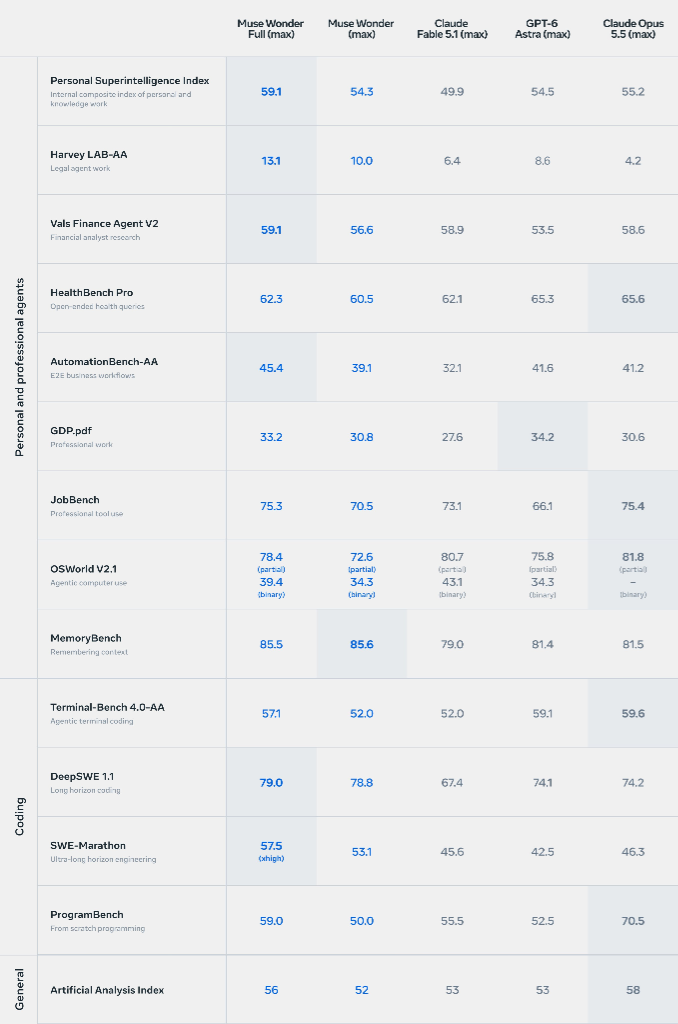
Official Benchmark Infographic: Meta Muse Wonder Full vs. Claude Opus 5.5, GPT-6 Astra, and Claude Fable 5.1 across all 14 evaluated disciplines
Head-to-Head Benchmark Scorecard
| Benchmark / Discipline | Muse Wonder Full | Claude Opus 5.5 | GPT-6 Astra |
|---|---|---|---|
| DeepSWE 1.1 (Bug Fixing) | 79.0% (#1) | 74.2% | 74.1% |
| SWE-Marathon (xHigh Compute) | 57.5% (+11.2) | 46.3% | 55.1% |
| ProgramBench (From-Scratch Apps) | 59.0% | 70.5% (#1) | 65.2% |
| MemoryBench (Retention) | 85.5% (#1) | 81.5% | 81.4% |
If your daily workflow revolves around large, messy codebases, hunting regression bugs, or managing continuous Docker deployments, Muse Wonder Full is arguably the most capable reasoning engine available today. But if your goal is rapid prototyping of new apps from a blank screen, Claude Opus 5.5 remains unmatched.
👉 For full architectural teardowns, real coding screencasts, and complete benchmark metrics, read our detailed Meta Muse Wonder Full review on SoftReviewed.


Comments
Post a Comment