GPT-6.1 Terra Pricing: Is OpenAI's 10x Cheaper Computer-Use Model Worth It?
GPT-6.1 Terra Pricing: Is OpenAI's 10x Cheaper Computer-Use Model Worth It?
When OpenAI announced their mid-tier foundation model for desktop automation, the single biggest number that caught my attention was not the benchmark score. It was the token bill. Previous frontier models like GPT-6 Astra charged an eye-watering $10.00 per million input tokens and $50.00 per million output tokens. If you ran an automated computer-use agent that captured full desktop screenshots every three seconds, you could easily burn through twenty dollars in an afternoon.
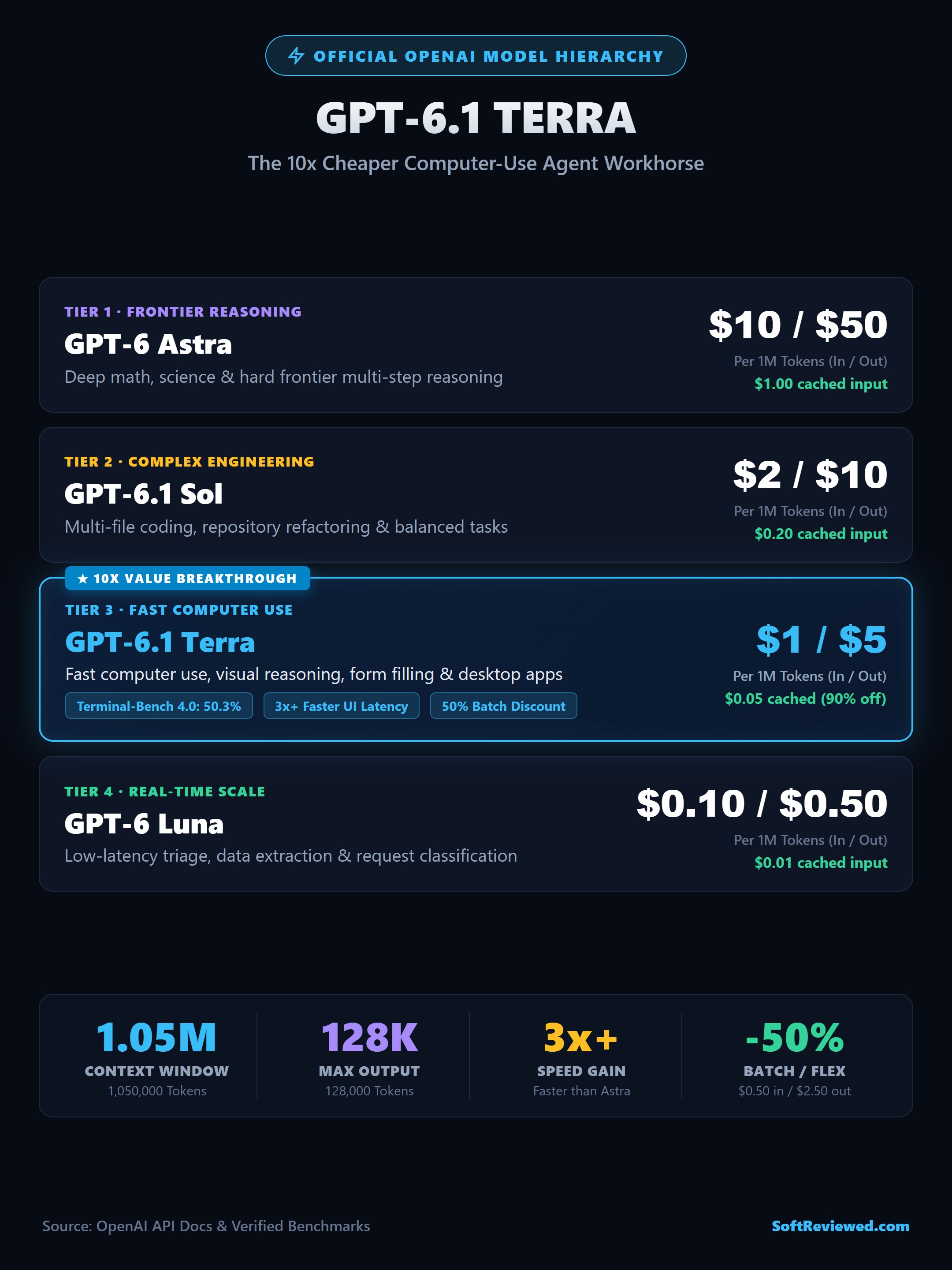
That financial headache changes completely with the release of GPT-6.1 Terra. Priced at just $1.00 per million input tokens and $5.00 per million output tokens, Terra slashes operating expenses by 90% while delivering three times faster execution speeds across web browsers and desktop software.

Breaking Down the 4-Tier OpenAI Model Hierarchy
To understand where Terra fits into your automation budget, you have to look at how OpenAI structured their current four-tier catalog. Rather than forcing developers to run heavy frontier reasoning engines for every routine browser click, OpenAI split responsibilities across distinct operational profiles:
- GPT-6 Astra ($10 in / $50 out): The heavy frontier reasoning engine designed for deep mathematical proofs, multi-step scientific logic, and high-stakes problem solving.
- GPT-6.1 Sol ($2 in / $10 out): The complex engineering model engineered for multi-file repository refactoring and full-stack software development.
- GPT-6.1 Terra ($1 in / $5 out): The fast computer-use workhorse built specifically to visually inspect user interfaces, click buttons, fill forms, and operate command terminals.
- GPT-6 Luna ($0.10 in / $0.50 out): The ultra-low-latency utility tier for triage classification, webhook parsing, and structured data extraction.
When I run autonomous agents on daily administrative tasks, 80% of the steps are routine: clicking confirmation dialogs, scrolling down spreadsheets, and waiting for page loads. Paying frontier rates for those repetitive steps never made financial sense. With Terra, those background loops run at a fraction of the cost.
Watch the 60-second video breakdown below:
Token Economics: Cached Prompt Discounts and Batch API Savings
The real game-changer for high-volume automation teams is the prompt caching pricing. OpenAI set cached inputs for Terra at just $0.05 per million tokens. Because computer-use agents send the same system prompt, tool definitions, and historical screenshots on every single turn, prompt caching kicks in on almost every consecutive API call.
Furthermore, if your computer-use tasks can run asynchronously in overnight queues, OpenAI's Batch and Flex API options apply an automatic 50% discount. That brings your costs down to $0.50 per million input tokens and $2.50 per million output tokens.
The Value Dilemma: When to Upgrade to Sol or Astra
Does Terra replace higher-tier models entirely? In my testing, the answer depends on cognitive depth. When an agent encounters an unexpected runtime error, an ambiguous layout shift, or a broken third-party API, Terra occasionally loops if the recovery requires complex multi-step reasoning.
For those high-ambiguity recovery steps, routing the single failing prompt to GPT-6.1 Sol or GPT-6 Astra while keeping 95% of routine clicks on GPT-6.1 Terra offers the ideal balance of reliability and token thrift.
For teams building production RPA pipelines, Terra turns computer-use automation from an expensive experiment into a profitable daily workflow.


Comments
Post a Comment