Google Genie 4 Pricing & Cloud Footprint: Is Real-Time 3D Simulation Worth Google AI Ultra?
Google Genie 4 Pricing & Cloud Footprint: Is Real-Time 3D Simulation Worth Google AI Ultra?
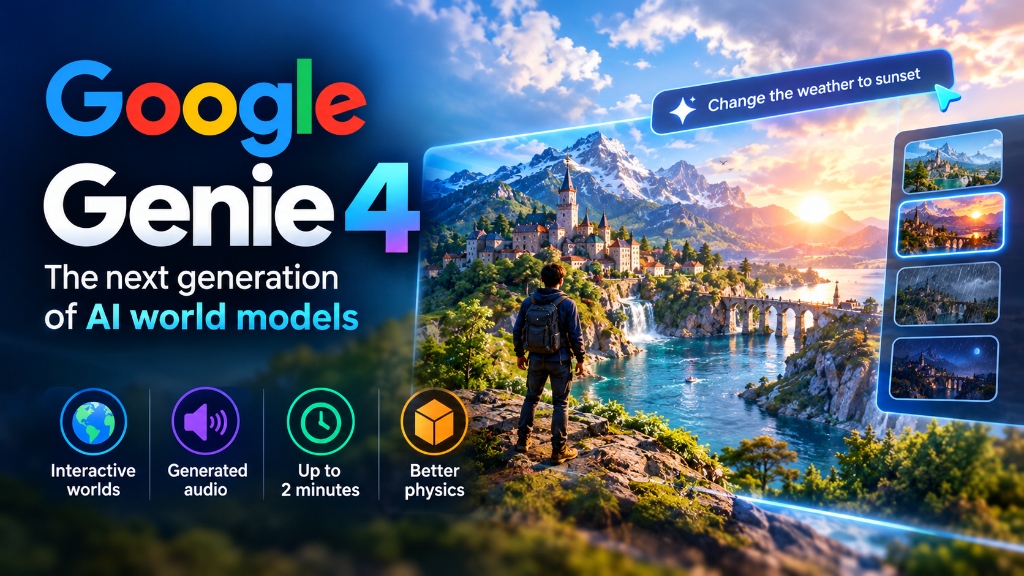
When Google DeepMind introduced Google Genie 4, the conversation immediately split between astonishment and hardware reality. Generating a five-second video clip offline on a shared cluster is one thing. Delivering an interactive, physics-grounded 3D world rendered in real time at 24 to 30 frames per second is an entirely different compute tier.
For developers, creators, and studio technical directors, the core question isn't whether the technology looks stunning—it clearly does. The question is what it actually costs to run, how Google plans to monetize access through Google AI Ultra, and whether real-time world generation provides genuine economic value compared to traditional graphics engines.
Watch the 60-second Google Genie 4 video walkthrough below:
The Hidden Compute Economics Behind Google Genie 4
Traditional generative video models like Runway Gen-3, Sora 2, or Google's own Veo operate on an asynchronous batch pipeline. You submit a prompt, wait twenty to sixty seconds while remote server GPUs chew through diffusion steps, and download a finished MP4 container. You pay per generated second—typically five to ten cents per run.
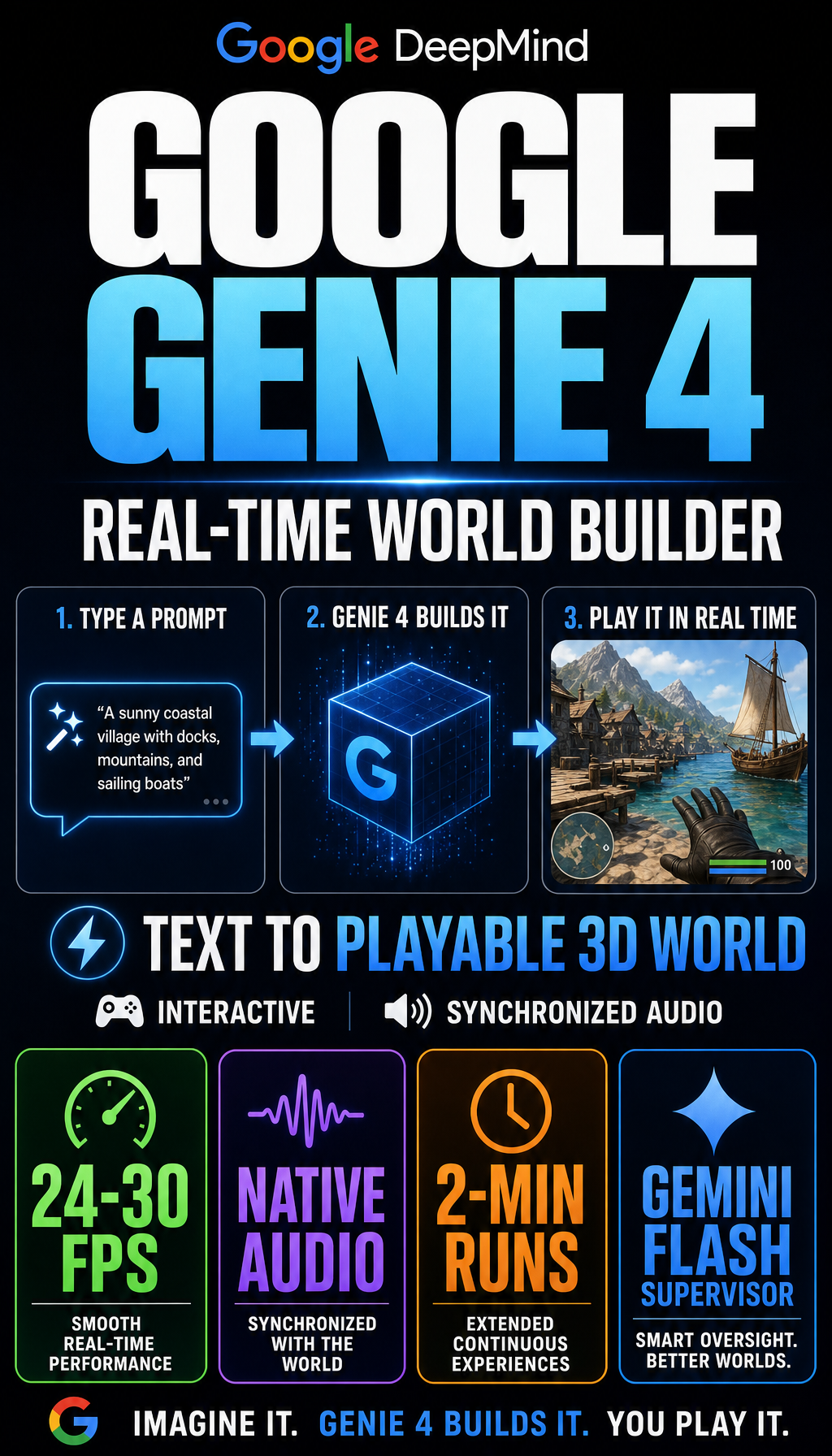
Google Genie 4 completely abandons the batch queue. Because users steer characters using keyboard, mouse, and microphone inputs with sub-100ms response targets, the model cannot afford multi-pass denoising or deep frame interpolation.
Instead, Genie 4 runs a streaming diffusion transformer paired directly with an internal cognitive supervisor powered by Gemini 3.8 Flash. That dual-model setup requires dedicated Tensor Processing Unit (TPU) hardware pinned directly to your active browser session:
- Dedicated Inference Reservation: Every interactive session ties up dedicated TPU v5e/v6e slices that cannot be multiplexed across other waiting users during live gameplay.
- Bi-Directional Multimodal Streaming: The model continuously receives real-time action vectors (steering coordinates, keypresses) while streaming back synced video frames and native stereo audio.
- Cognitive Working Memory: Gemini 3.8 Flash runs concurrently in the background, updating spatial state maps every few frames to prevent catastrophic forgetting.
When you factor in that compute load, running an interactive world model is roughly four to six times more expensive per minute than streaming pre-rendered cloud gaming through GeForce NOW or Xbox Cloud Gaming.
Tier Access: Free Preview vs Google AI Pro vs Ultra
Google has structured the rollout of Google Genie 4 across three distinct operational tiers to protect server headroom while collecting telemetry:
1. The Playground Sandbox (Free / Partner Tier)
In the introductory sandbox, users receive capped interactive sessions limited to 60 or 90 seconds. Resolution is locked to 720p at 24 FPS, with prompt steering restricted to basic weather and lighting adjustments. It serves as an impressive technology showcase, but it shuts off before any sustained gameplay or narrative continuity can develop.
2. Google AI Pro ($20 / Month)
The standard developer tier increases session continuity to the full 120-second (2-minute) horizon and enables live dialogue generation with non-player characters (NPCs). However, peak-hour queue gating applies, and sustained generation consumes monthly compute credits similar to high-resolution image quotas.
3. Google AI Ultra & Enterprise Cloud API
For game studios, robotics teams, and virtual production houses, Google AI Ultra provides dedicated session capacity, custom action-policy fine-tuning, and direct API endpoints. Pricing shifts from fixed monthly subscriptions to metered session minutes, estimated between $0.15 and $0.35 per active simulation minute.
Is Google Genie 4 Worth the Premium Over Traditional 3D Assets?
To evaluate the return on investment, you have to look at where production teams waste time today. In game pre-visualization and cinematic pitch decks, building a 3D block-out of a fantasy village or sci-fi space station takes a team of environment artists several days in Unreal Engine 5 or Blender:
- Asset Procurement: Sourcing textures, meshes, and lighting rigs ($500 to $2,000 in marketplace assets).
- Scene Setup: Aligning collision meshes, configuring skyboxes, and testing camera paths (15 to 40 artist hours).
- Audio authoring: Adding footsteps, ambient wind, and background music in separate audio software.
With Google Genie 4, a creative director types a three-sentence prompt, grabs a game controller, and walks an executive through the exact concept in under sixty seconds—complete with reactive ambient noise and responsive NPC dialogue. For rapid pre-production and ideation, paying twenty dollars a month or a few dollars per simulation hour is an absolute bargain compared to studio payroll hours.
However, for commercial games intended for mass consumer distribution, Genie 4 cannot replace a compiled C++ game binary. The running cost of streaming an AI-generated world to millions of players simultaneously remains mathematically prohibitive.
For full architectural breakdowns, benchmark latency comparisons, and release updates, explore our hands-on analysis of Google Genie 4 on SoftReviewed.


Comments
Post a Comment