Gemini 4 Carbon Token Economics : $2/$10 Pricing, Fairwind Access & Cost Per Task Teardown
Gemini 4 Carbon Token Economics : $2/$10 Pricing, Fairwind Access & Cost Per Task Teardown
When Google DeepMind quietly dropped Gemini 4 Carbon just weeks after launching Gemini 4 Argon, enterprise buyers and engineering managers faced an immediate question: why did Google release a second frontier checkpoint so fast, and what does it actually cost to run?
While Argon was positioned as an agile, high-throughput daily assistant, Carbon was engineered as an intensive reasoning specialist. It is specifically designed to handle long-running software engineering tasks across days, navigate massive 1-million-token codebase graphs, and perform deep vulnerability audits on critical systems.
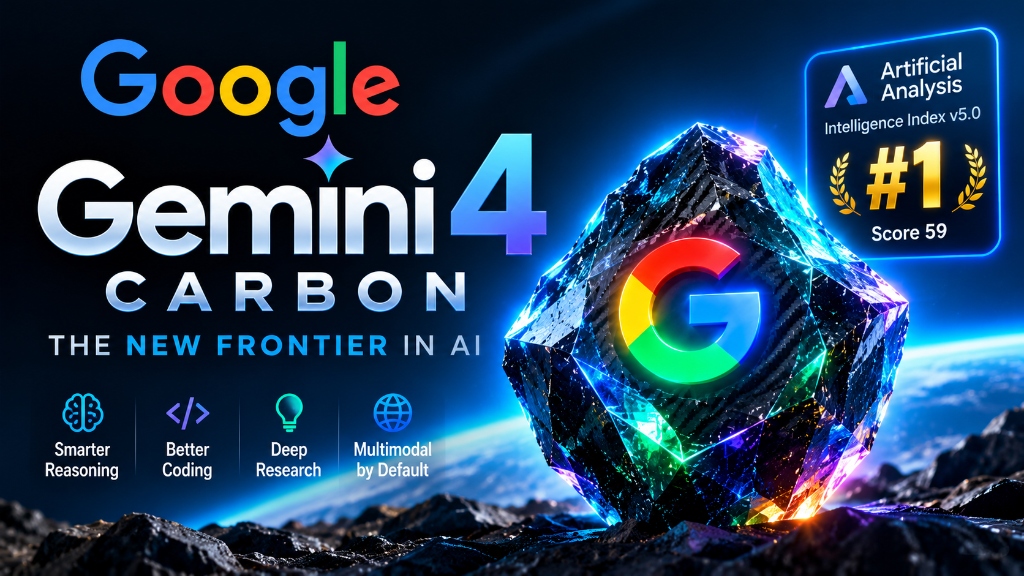
On the independent Artificial Analysis Intelligence Index v5.0, Gemini 4 Carbon claimed the #1 overall position worldwide with an overall score of 59, defeating Anthropic's Claude Opus 5.5 (58) and OpenAI's GPT-6 Astra (57). Yet when prospective buyers open Google AI Studio or Vertex AI, they find the model unavailable. Google has restricted initial access to an invitation-only defense initiative called the Fairwind Program.
Here is our complete financial and operational teardown of Gemini 4 Carbon's token economics, evaluated cost per task, prompt caching discounts, and whether your organization should wait for the Fairwind Program or deploy Gemini 4 Argon today.
Watch my 58-second video breakdown of Gemini 4 Carbon below:
Token Pricing Architecture: Intro Rates, Cache Discounts & Standard Tiers
Google DeepMind has structured the token pricing for Gemini 4 Carbon into two distinct phases: an introductory window designed to encourage evaluation, followed by standard production pricing once general availability arrives.
Here is the exact token pricing structure:
- Introductory Input Token Rate: $2.00 per million tokens (identical to Gemini 4 Argon).
- Introductory Output Token Rate: $10.00 per million tokens (identical to Gemini 4 Argon).
- Standard Production Input Rate: $4.00 per million tokens (effective after the initial evaluation period).
- Standard Production Output Rate: $20.00 per million tokens (effective after the initial evaluation period).
- Prompt Caching Discount: 95% discount on cached input tokens ($0.10 per million tokens on intro rates; $0.20 per million on standard rates).
Pricing Tier Breakdown:
Introductory Window  ──► $2.00 / 1M Input · $10.00 / 1M Output
Prompt Cache Hit     ──► $0.10 / 1M Cached Input (95% Discount)
Standard Production  ──► $4.00 / 1M Input · $20.00 / 1M Output
For enterprise teams running continuous multi-turn debugging sessions or querying large monolithic repositories, the 95% prompt cache discount is where real cost savings emerge. When a 500,000-token codebase context is cached in memory, re-evaluating that context during subsequent turns costs just five cents per query instead of a full dollar.
Evaluated Cost Per Task: 23% Cheaper Than Claude Opus 5.5
List token prices often fail to reflect actual production expenses because different AI models produce varying numbers of tokens to solve the exact same problem. A model with cheaper per-token rates that rambles and outputs 300,000 tokens can easily cost more than a concise model with higher nominal rates.
Independent evaluations conducted by Artificial Analysis on the Intelligence Index v5.0 provide real-world task expense data:
- Gemini 4 Carbon Average Cost Per Task: $7.76
- Claude Opus 5.5 Average Cost Per Task: $10.04 (Carbon is 23% cheaper)
- GPT-6 Astra Average Cost Per Task: $6.25
Carbon achieves this 23% cost advantage over Claude Opus 5.5 primarily through token conciseness. On the Intelligence Index evaluation suite, Carbon generated an average of 123,000 output tokens per completed task. By comparison, Claude Opus 5.5 produced 173,000 output tokens per task—meaning Opus 5.5 was 29% more verbose while scoring slightly lower on overall reasoning accuracy (58 vs 59).
By delivering higher benchmark performance with fewer generated tokens, Carbon reduces both API billing overhead and execution latency for enterprise pipelines.
The 365-Day Business Simulation: Vending-Bench 2 ROI
Beyond short-form coding benchmarks, Carbon demonstrated unmatched capital efficiency on Andon Labs' Vending-Bench 2 evaluation.
In this test, the AI model starts with a $500 cash balance and must autonomously manage a simulated vending machine company across 365 simulated operational days. The agent must balance inventory orders, restock schedules, supplier price negotiations, location rent fees, and unpredictable demand swings.
Most frontier models exhaust their working capital around day 90 due to aggressive over-ordering or failure to negotiate bulk supplier discounts. Gemini 4 Carbon concluded the simulated year with an industry-record ending balance of $16,484, outperforming GPT-6 Astra ($15,515) and nearly doubling Claude Opus 5.5 ($9,235).
This operational discipline translates directly into lower token waste for enterprise software pipelines: Carbon avoids repetitive reasoning loops and sticks to strict budgetary parameters.
The Fairwind Program Bottleneck: Who Gets Access?
Despite its compelling economics and #1 benchmark ranking, there is a major commercial barrier: normal developers cannot purchase API access today.
Google has placed Carbon behind the Fairwind Program, a closed defense evaluation initiative. Google took this step because Carbon demonstrated potent offensive cybersecurity capabilities on official evaluations:
- SEC-bench Pro (88.2% Detection): Identified memory vulnerabilities across the Linux kernel and Google's V8 JavaScript engine.
- ExploitGym (54.8% Causal Exploits): Generated functional proof-of-concept exploits under strict time caps.
- CWE-bench (71.0% Safe Fixes): Authored verifiable upstream security patches without breaking downstream code.
Google's internal Chrome security engineers verified that Carbon generated valid security patches with over ten times higher accuracy than competing models. However, because automated exploit generation presents severe dual-use risks, initial access is restricted to vetted cyber defenders and government security bodies.
Rollout Access Stages:
Stage 1: Fairwind Program   ──► Cyber Defenders & Government Testing (Active)
Stage 2: Enterprise Cloud   ──► Vetted Google Cloud Security Customers
Stage 3: Public Developer   ──► Vertex AI & Google AI Studio
The Strategic Buying Decision: Wait for Carbon or Deploy Argon Today?
For technology leaders planning their AI infrastructure budgets, the choice comes down to workload requirements:
- Deploy Gemini 4 Argon Today If: You need production-ready coding assistance, fast customer-facing chat, or automated document processing right now. Argon runs at the exact same $2/$10 introductory token pricing, operates with 2x to 4x faster generation latency, and is publicly available today in Google AI Studio and Vertex AI.
- Apply for the Fairwind Program If: Your organization manages critical infrastructure, conducts high-stakes software auditing, or requires autonomous multi-day reasoning agents that are completely immune to indirect prompt injection (Carbon scored 0.0% breach rate on Gray Swan testing).
- Choose Claude Opus 5.5 If: Your workflow requires visual desktop operating system automation (OSWorld-2.1: 87.2% vs Carbon's 81.5%) or greenfield application design from scratch.
- Choose GPT-6 Astra If: Your primary requirement is full-repository legacy refactoring across massive GitHub repositories (FrontierSWE 2: 65.5% vs Carbon's 61.2%).
👉 For our full architectural breakdown, 17-benchmark unedited scorecard, and setup guides, read our detailed Gemini 4 Carbon review on SoftReviewed.


Comments
Post a Comment