Claude Duet Pricing Breakdown: Why Anthropic Included It in $20 Pro While OpenAI Charges $100 for Dots
If you have been paying attention to the AI agent race over the past two months, one big question is dominating every business forum and Slack group: how much is an always-on AI assistant going to cost you each month? With OpenAI pricing ChatGPT Dots at a steep $100 per month, Anthropic's announcement that Claude Duet is included inside their standard $20 per month Claude Pro subscription felt like a shock to the industry.

When I first heard about the launch, my initial thought was that Anthropic must be cutting corners or hiding extra token fees behind the scenes. An AI agent that runs on a dedicated cloud computer 24 hours a day while your phone is off cannot be cheap to operate. But after reviewing the official documentation, running the math on background compute cycles, and seeing how it stacks up against competitors, the reality is much more interesting. In this breakdown, I will walk you through the true cost of running Claude Duet, why Anthropic bundled it this way, and whether it makes financial sense for your daily work.
If you are just getting started and wondering what is Claude Duet, it is an autonomous operations assistant powered by Anthropic's frontier Claude Opus 5.5 model that executes multi-step tasks in the background on its own virtual machine.
The $20 vs $100 Dilemma: Anthropic vs OpenAI
The biggest contrast in the current agent market is between Anthropic and OpenAI. Both companies are pitching the exact same vision: an intelligent assistant that checks your email, organizes your files, monitors your spreadsheets, and drafts work while you sleep. Yet their pricing strategies could not be further apart.
OpenAI decided to lock ChatGPT Dots behind their ChatGPT Pro tier at $100 per month (or their enterprise Business plans). If you are on the standard $20 ChatGPT Plus subscription, you cannot use Dots to run autonomous background workflows. That creates a massive barrier for freelancers, small business owners, and solo operators who cannot justify spending $1,200 a year just to test an agent.
Anthropic took the opposite route. Claude Duet is included for anyone with an active Claude Pro ($20/month) or Claude Max plan. There is no separate $80 add-on fee, and there is no hidden paywall. If you already subscribe to Claude Pro to access Claude Opus 5.5 and Sonnet, you are already paying for Duet access once you clear the preview waitlist.
Here is how the four major frontier agents compare on monthly subscription costs:
| Agent Platform | Monthly Cost | Plan Tier Required | Extra Compute Fees? |
|---|---|---|---|
| Claude Duet | $20 / month | Included in Claude Pro & Max | Shared 5-hour compute pool |
| ChatGPT Dots | $100 / month | ChatGPT Pro or Business | High compute tier included |
| Grok Bot | $30 / month | X Premium / Cursor integration | Billed via X subscription |
| Meta Muse | Included | Select Meta tiers & WhatsApp | Limited free consumer tier |
When you look at this table, the value proposition of Claude Duet stands out immediately. You are getting frontier-grade Opus 5.5 intelligence for one-fifth of what OpenAI demands for GPT-6 Astra on Dots.
How Background Compute Works (The Shared Pool Catch)
Now, let's talk about the catch. Nothing in cloud computing is truly free, and Anthropic is not running unlimited cloud servers out of charity.
When you run Claude Duet, its background monitoring cycles share your existing 5-hour usage limit and weekly compute allowances. In Claude Pro, you get a generous pool of messages and compute that refreshes every 5 hours. If you spend your morning chatting directly with Opus 5.5 in the main chat window, you are drawing from the exact same bucket of compute that Duet uses to scan your integrations in the background.
Your Claude Pro Subscription ($20/mo)
            ↓
┌──────────────────────────────────────────────┐
│       Shared 5-Hour Compute Allowance        │
├──────────────────────┬───────────────────────┤
│ Active Web Prompts   │ Duet Background VM    │
│ (Chatting with Opus) │ (Hourly scans, email) │
└──────────────────────┴───────────────────────┘
This means that if you set Duet to check 20 different connectors every thirty minutes, you will burn through your 5-hour allowance faster than expected. For solo consultants or small agency owners who keep a moderate schedule, the standard $20 Pro pool is plenty. But if you have heavy daily prompting needs, you might eventually need to step up to Claude Max to give your agent breathing room.
To see the agent in action and understand how its cloud computer operates without draining your local laptop battery, watch my 50-second overview of Claude Duet below:
Watch my 50-second overview of Claude Duet below:
What About Grok Bot and Meta Muse?
To make an informed buying decision, you also need to know what xAI and Meta are offering in this price bracket.
xAI's Grok Bot sits at $30 per month via X Premium. Grok Bot takes a very different architectural approach: instead of giving you one polished personal assistant, it gives you a fleet of up to 50 specialized mini-agents. You can have one bot tracking tech news, another bot testing code, and a third bot watching financial filings. If you are a hardcore developer who wants raw, unconstrained automation and no waitlist, Grok Bot at $30 is a very tempting deal. But it lacks the clean, polished morning briefing experience that Anthropic built into Duet.
Meta's Muse, on the other hand, is built directly into WhatsApp and Instagram. It is aimed at everyday consumers rather than business back offices. While Muse is cheap and accessible, it cannot connect to your accounting software, manage your customer payroll in Gusto, or inspect your GitHub repositories.
If your daily goal is business productivity—managing client communications, drafting invoices, and organizing morning briefs—neither Grok nor Muse matches the corporate focus of Claude Duet.
Visualizing the 2026 Agent Architecture
To help you compare the pricing, target audience, and system limits of all four major agents at a single glance, I put together this architectural comparison guide:
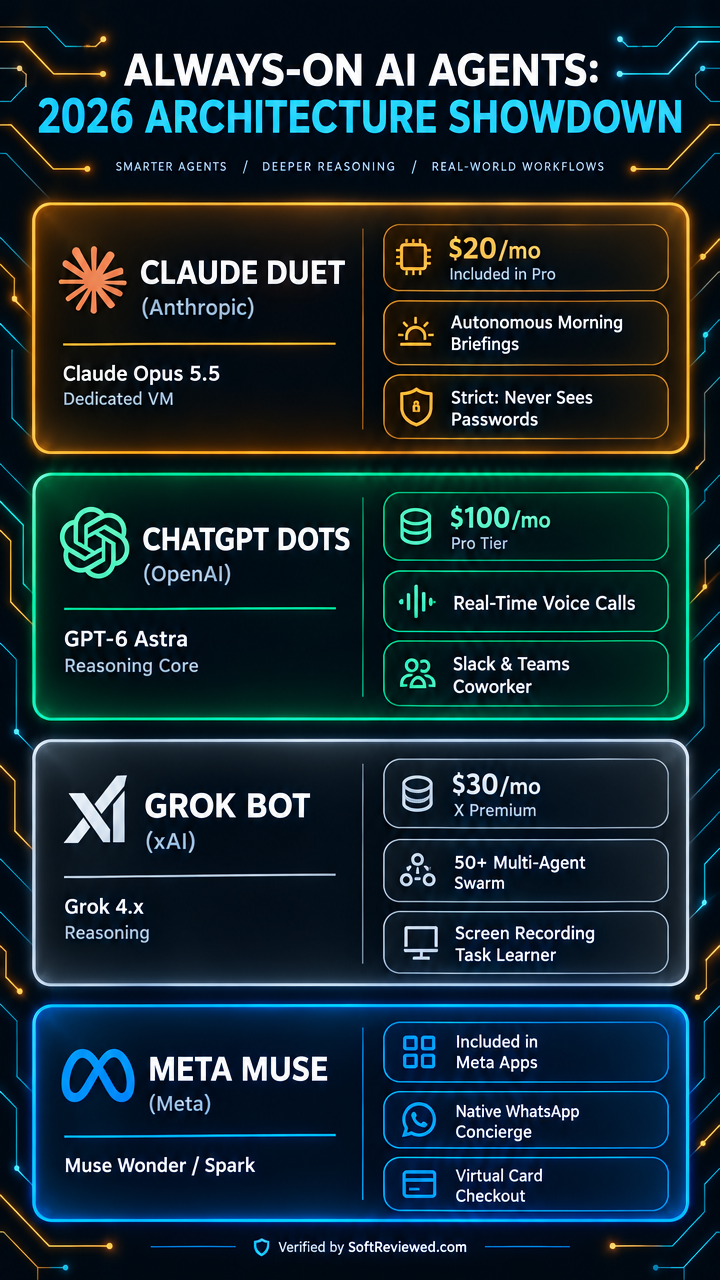
As shown in the comparison, Anthropic designed Duet around strict safety rails. Unlike consumer bots that might click dangerous links or accidentally authorize financial transactions, Duet has hard-coded blocks against moving money or trading stocks. Even if you explicitly tell it to transfer funds between accounts, its safety classifier intercepts the command and halts execution immediately.
Is Claude Duet Worth the $20 Investment?
In my experience testing automation tools, the real test of software value is whether it saves you more time than it costs in subscription fees.
If you spend even thirty minutes every morning sorting through messy email threads, checking whether client payments cleared in Stripe, and writing down your daily agenda, Claude Duet easily pays for itself on day one. A dedicated human virtual assistant costs anywhere from $500 to $2,000 per month. Paying $20 per month for an Opus 5.5 agent that handles your routine administrative scans while your laptop lid is shut is one of the highest-leverage bargains in tech right now.
To help you decide whether your current workflow fits Anthropic's model, keep these three guidelines in mind:
- Pick Claude Duet if you want a reliable, quiet operations assistant that prioritizes privacy, never touches your raw passwords, and gives you a structured executive brief every morning for just $20 a month.
- Pick ChatGPT Dots only if your entire team already lives inside Slack or Microsoft Teams and you require real-time voice calls with your agent on the road.
- Pick Grok Bot if you need instant global access without a waitlist and love deploying multi-agent swarms for coding and scraping.
For a deeper dive into the technical virtual machine architecture, connector security protocols, and step-by-step waitlist instructions, read my complete guide explaining what is Claude Duet on SoftReviewed.


Comments
Post a Comment