OpenAI GPT-6 Sol and Luna Released: 50% Price Drop, 1.05M Context & Real-World Benchmarks
Production Economics: The GPT-6 Sol & Luna Shift
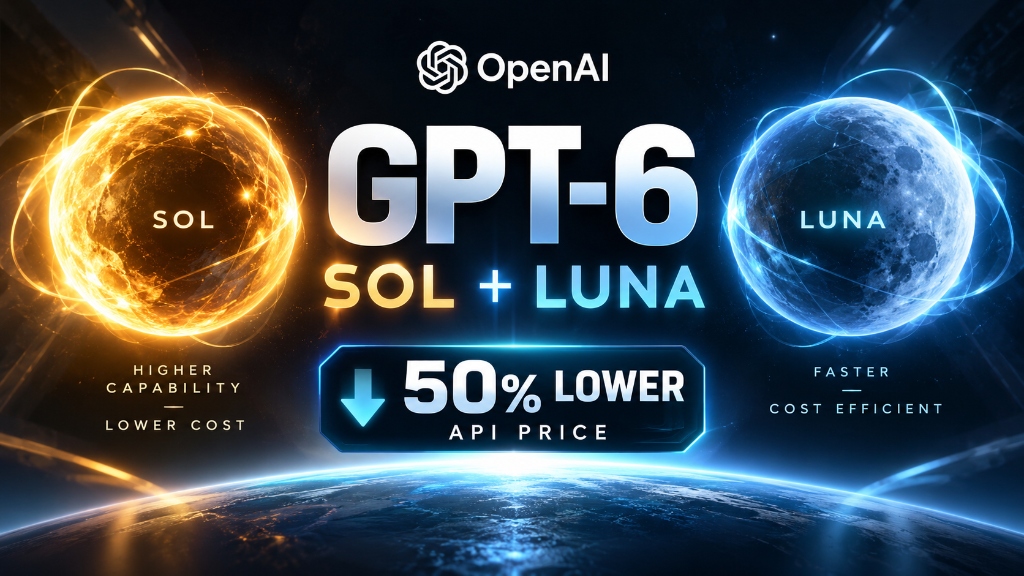
OpenAI has officially launched GPT-6 Sol and GPT-6 Luna, expanding the frontier GPT-6 tier alongside the flagship GPT-6 Astra. While frontier AI announcements often prioritize synthetic academic test scores, Sol and Luna represent an immediate, pragmatic transition focused entirely on inference economics, latency, and continuous agent loops.
Priced at $2.00 per million input tokens and $10.00 per million output tokens on Sol, and an ultra-lean $0.10 input / $0.50 output on Luna, OpenAI has reduced base API costs by 50% compared to previous generation flagships. Most crucially for engineering teams deploying autonomous coding systems, prompt cache read costs have dropped by 90% down to $0.20/M on Sol and $0.01/M on Luna.
Comparative Scorecard & Pricing Matrix
| Metric / Specification | GPT-6 Sol | GPT-6 Luna | GPT-5.6 Sol |
|---|---|---|---|
| Input Price / 1M Tokens | $2.00 | $0.10 | $4.00 |
| Output Price / 1M Tokens | $10.00 | $0.50 | $20.00 |
| Prompt Cache Read / 1M | $0.20 (-90%) | $0.01 (-90%) | $2.00 |
| Context Window | 1,050,000 | 1,050,000 | 256,000 |
| AutomationBench 1.0.6 | 33.2% | 16.4% | 24.8% |
| Inference Throughput | ~65 t/s | 175 t/s | ~50 t/s |
Autonomous Coding Performance: AutomationBench 1.0.6
In real-world developer workflows, theoretical math problems matter far less than multi-file refactoring, terminal shell execution, and test-driven debugging. On AutomationBench 1.0.6—which tests multi-hour agent operations without human oversight—GPT-6 Sol achieved 33.2%, establishing a new efficiency benchmark for sub-$3 models.
Operational Deficits & Limitations: Where It Falls Short
No model evaluation is complete without highlighting where the architecture encounters bottlenecks:
- Luna Coding Regression: GPT-6 Luna scores only 16.4% on AutomationBench. It should be strictly reserved for fast document classification, sentiment scoring, and routing, rather than software development.
- Ambiguous Prompt Guardrails: GPT-6 Sol demonstrates higher false-positive refusal rates on edge security questions compared to GPT-5.6 Sol unless explicitly bound with system rules.
- High-Reasoning Latency: When set to maximum reasoning effort, token output speeds throttle down to ~45 t/s, making it unsuitable for real-time customer chatbots.
Architectural Verdict & Full Review
By pairing a 1.05M context window with 90% prompt cache deflation, GPT-6 Sol transforms continuous software engineering loops into an accessible daily baseline.
👉 Read the complete, unedited technical review, benchmark scorecards, and setup guide on SoftReviewed:
SoftReviewed: OpenAI GPT-6 Sol & Luna Complete Architecture Breakdown & Benchmarks


Comments
Post a Comment