Is a 20-Cent Model Good Enough? GLM-5.3-Flash vs Gemini, Honestly

There is a new cheapest option on the board, and unusually, it is not also the worst one. The question this post is trying to answer is narrower than "is GLM-5.3-Flash good" — it is whether it is worth changing anything you are currently doing.
What it costs
Twenty cents per million tokens, or from eighteen dollars a month if you would rather buy a subscription than meter tokens. That second number needs a caveat almost nobody repeats: the coding plans are credit-based, and every tier carries two ceilings at once — a rolling five-hour allowance and a weekly one. The entry Lite tier is 2,000 credits per five hours and 10,000 per week, per Z.ai's own developer documentation. It is a subscription, but it is not an unmetered one. The comparison everyone reaches for is Gemini, which lands at roughly nineteen times the per-token figure. Z.ai is also handing out 100 trillion tokens free at launch, which means the evaluation itself is free — we walked through how the coding plan pricing actually works once the launch window closes, because that is the number that will still be there in three months.
Three questions that decide it
1. Is your workload documents or code?
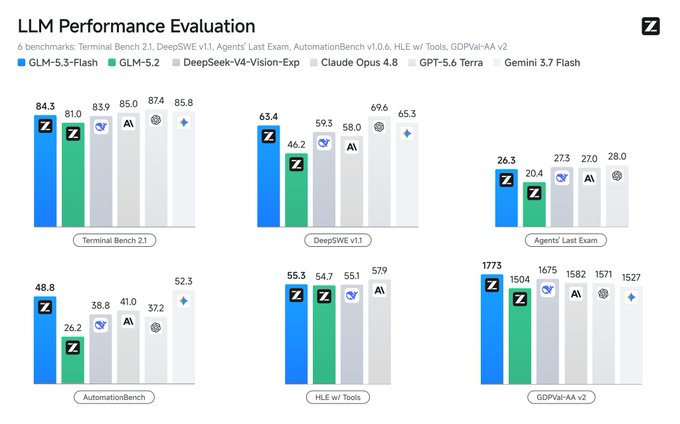
This is the whole decision, really. On real office work — documents, spreadsheets, presentations, the four file types most teams actually live in — GLM-5.3-Flash is ranked first in the world, 1,773 against a 1,582 field. On code it comes second to Gemini, 63.4% against 65.3%. Neither of those is a rounding error you can wave away, and the full benchmark table, broken out by task type, is worth reading before you commit a pipeline to either one.
2. How long are your inputs?
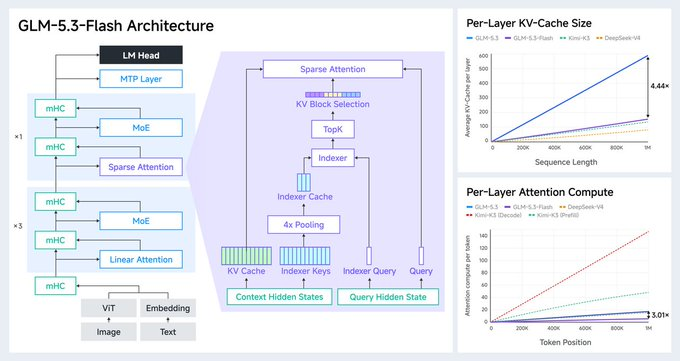
It reads a million tokens in one pass. Gemini reads 128k. If you routinely paste in something that has to be split before it fits, this is the more interesting number than the price, because chunking is where accuracy quietly goes to die.
3. Are you replacing a tool or adding one?
Most people asking about this model are framing it as a replacement, and that framing is what leads to disappointment. At twenty cents, running it alongside what you already have costs almost nothing. Send it the contracts, the reports and the long-document work; leave the build pipeline where it is.
One thing worth knowing: you can download it
The part that gets lost in the pricing conversation is that GLM-5.3-Flash is open weight, released under the MIT licence. The model card lists 321,323,031,390 parameters across 45 layers, and the architecture is a mixture-of-experts design with 288 routed experts of which just 8 fire on any given token, plus one shared expert that is always on.
That ratio is the whole reason the price is what it is. You get a 321-billion-parameter model's knowledge while paying to activate a small fraction of it per token.
Before you get ideas about self-hosting, though: the published weights are FP8, and they come to roughly 314 GB before you allocate a single byte of KV cache. Open weights are a licensing freedom here, not a hardware one. For almost everyone the API is the only realistic route — the MIT licence matters because it means nobody can pull the model out from under you, not because you are going to run it in your office.
The context window checks out exactly, incidentally: the config declares 1,048,576 positions. We kept this out of the main breakdown, which stays focused on the buying decision.
The short version
Switch your document and long-context work over — the price difference is large enough that hesitating is the expensive option. Do not switch your coding work over, because the benchmark says you would be trading down, and it is not a close enough win on cost to justify it.
Anyone telling you it beats Gemini outright has skipped the coding row of the table. We put the whole thing side by side, including the context-window and pricing maths, in our full GLM-5.3-Flash breakdown on SoftReviewed.


Comments
Post a Comment